








































Designing Cabinetry for Infection Prevention

By:
Marketing Manager, Midmark Medical
April 27, 2026
Infection Prevention Starts with the Environment
Infection prevention is often discussed in terms of protocols, products and staff training. Those elements matter, but the physical environment matters too.
In outpatient settings, safe care depends on more than what staff do. It also depends on whether the space supports consistent cleaning, organization and workflow. That is why cabinetry deserves more attention during planning and renovation discussions.
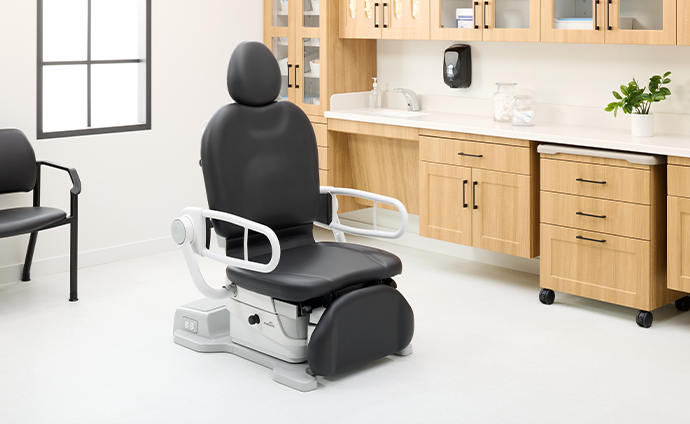
In a busy medical space, cabinetry is touched throughout the day, used to organize supplies and relied on to support room turnover and cleaning routines. When cabinetry is designed for the clinical environment, it can help simplify cleaning, reduce clutter and support more consistent workflows. Synthesis® Cabinetry is designed for the clinical environment to support workflow, ergonomics, technology integration and infection prevention at the point of care.
Why Medical Cabinetry Matters for Infection Prevention
Cabinetry may not be the first thing clinical teams think about when discussing infection prevention, but it affects daily practice in important ways.
When surfaces are difficult to clean, storage contributes to clutter or layouts force caregivers to move around the room inefficiently, it becomes harder to maintain a clean, organized care environment. Over time, those design choices can affect room turnover, consistency and confidence in infection prevention processes.
Cabinetry designed for clinical use can help reduce those challenges. Synthesis Cabinetry uses seamless surfaces to simplify cleaning, and its surfaces are tested against medical-grade cleaners to support long-term durability. Midmark’s cabinetry white paper also frames infection prevention and durability as key considerations when evaluating cabinetry for non-acute environments.
The takeaway is simple: cabinetry is more than a design detail. It is part of the infection prevention strategy.
What to Look for in Medical Cabinetry for Infection Prevention
When selecting medical cabinetry, decision-makers should evaluate four core areas: cleanability, material durability, storage design and workflow support. This makes the selection process more practical and helps connect cabinetry choices to day-to-day clinical performance.
Easy-to-Clean Surfaces
Look for smooth, seamless surfaces that are easier to wipe down and less likely to create hard-to-clean transition points. Seamless design can help support more efficient cleaning routines in clinical spaces.
Materials That Can Withstand Clinical Cleaning Protocols
Cabinetry in medical spaces needs to hold up to repeated use of approved cleaners. That matters because even strong infection prevention protocols can be undermined if surfaces degrade under normal cleaning routines. Durable materials help protect both appearance and performance over time.
Storage That Reduces Clutter
Well-planned storage helps keep essential supplies organized and surfaces clearer. That can make rooms easier to clean and easier for staff to work in. It can also support more consistent room setup across exam spaces.
Design That Supports the Way Care Is Delivered
Cabinetry should support the clinical workflow, not compete with it. Placement, access and storage configuration all affect how efficiently caregivers move through the room. Purpose-built clinical cabinetry can support workflow, ergonomics, technology integration and infection prevention together.
How Clinical Cabinetry Supports Workflow and Patient Safety
For medical teams, infection prevention and workflow are closely connected. When staff can quickly access supplies, maintain cleaner surfaces and work in a more organized room, they are better positioned to focus on patients instead of workarounds.
That matters because medical buyers and influencers prioritize patient safety, total cost of ownership, product quality and workplace efficiency in purchasing decisions. Cabinetry that supports standardized room setup can help meet those needs while creating a more consistent care environment.
Instead of adapting to a space planned around construction convenience alone, caregivers can work in an environment designed around real clinical tasks. That is where medical cabinetry becomes more than storage. It becomes part of the care experience.
When evaluating medical grade cabinetry, modularity is an important consideration. As healthcare environments continue to evolve, modular cabinetry helps ensure spaces remain functional, efficient, and accessible—allowing practices to adapt to changing care models without disruption, delays, or costly redesigns.
Common Mistakes to Avoid When Choosing Medical Cabinetry
When selecting cabinetry for a clinical project, a few common mistakes can undermine both performance and value:
- Choosing cabinetry based mainly on appearance instead of clinical function
- Overlooking how seams, corners and surface transitions affect cleanability
- Failing to consider how repeated exposure to approved cleaners will affect durability
- Underplanning storage, which can lead to cluttered countertops and inconsistent room setup
- Treating cabinetry as a construction detail instead of a contributor to infection prevention and workflow
These issues matter because Midmark’s white paper points to infection prevention, durability, flexibility and adaptability as core reasons cabinetry design should factor into purchasing decisions.
A Better Question to Ask During Planning
Instead of asking only, “What cabinetry fits the space?” a better question may be, “What cabinetry helps this space perform better every day?”
That shift reframes the conversation. It moves cabinetry from being a background decision to being part of the clinical strategy. In practical terms, teams should evaluate whether a cabinetry solution can:
- Simplify cleaning
- Stand up to clinical cleaning protocols
- Reduce visible clutter
- Improve organization at the point of care
- Support efficient staff movement
- Continue performing well over time
For teams planning a new build, renovation or exam room refresh, those questions can lead to better decisions for infection prevention, staff efficiency and long-term value.
How to Choose Medical Cabinetry for Long-Term Clinical Performance
Cabinetry plays an important role in helping medical spaces stay cleaner, work better and support safer care. When it is designed for the realities of the clinical environment, it can do more than store supplies. It can support infection prevention goals, improve workflow and help create a more resilient space for staff and patients.
Explore Midmark Synthesis Cabinetry options to see how cabinetry designed for the clinical environment can support infection prevention, workflow and long-term performance.
Additional Reading:
- White Paper: Choosing Cabinetry That Brings Value to Your Clinical Environment
- Webinar: Choosing Cabinetry That Brings Value to Your Clinical Environment