






















Oncology Care
RTLS Case Studies
CAREFLOW™ PATIENT FLOW FOR ONCOLOGY
More than 2 million Americans will be diagnosed with cancer this year1 and begin a complex journey of care often requiring multiple services within every patient visit. At the same time, growing numbers of cancer patients are seeking treatment in more convenient outpatient settings, challenging health systems to meet their needs more efficiently and collaboratively.
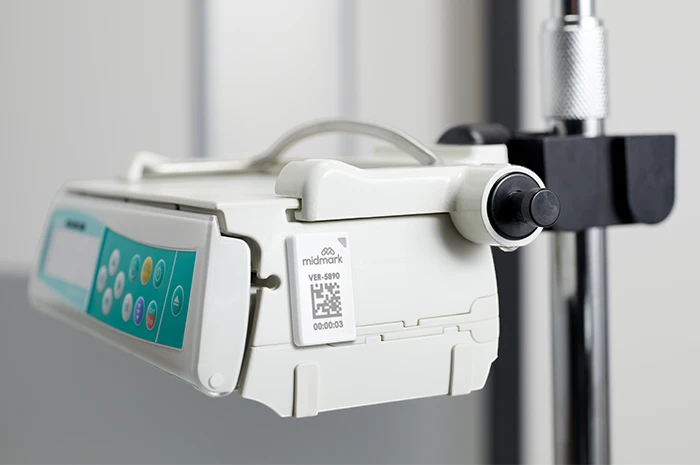
Effectively coordinating care for a growing oncology population is no easy task. Yet, leading cancer centers are finding that technology can play a significant role in streamlining care delivery. Many rely on real-time locating system (RTLS) technology to manage the flow of patients, staff and equipment throughout their facilities. In-the-moment visibility to clinic operations, coupled with rich aggregate data, is helping to optimize care delivery and the overall patient experience.
PATIENT SATISFACTION: EASING THE STRESS OF TREATMENT
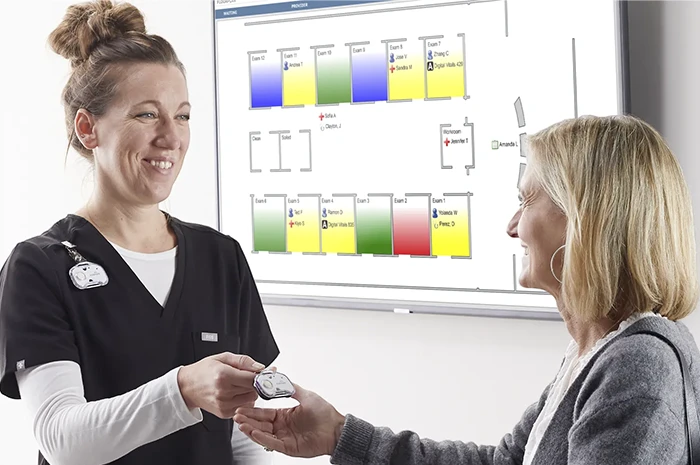
A patient’s time is valuable, and wait times can understandably escalate patient stress and frustration. As Brenda Farnham, MBA, BSN, RN, OCN, associate vice president, oncology services at Northern Light Cancer Institute, shares, “They don’t want to spend it sitting in the waiting room or waiting for their next stage of care." 2 Her facility uses the Midmark CareFlow RTLS Patient Flow solution to monitor wait times. Patients wear discreet badges that communicate their exact location and how long they’ve been waiting, allowing staff to proactively check in with patients to provide status updates and ease the frustrations of waiting.
Memorial Sloan Kettering Cancer Institute integrates Midmark CareFlow RTLS with an interactive patient system to ease the patient experience. According to Daniel Stein, MD, PhD, director of informatics and innovation, “When you’re in the hospital, a lot of people are coming in and out of the room. Sometimes it’s hard to keep track of who’s who, especially if you’re a little disoriented or if you’re on pain medications. One of the nice patient-facing applications of CareFlow Patient Flow is that when you walk into one of our rooms, there’s a TV on the wall and up on the TV will pop the name of the clinician and their role. That gives people a clue of who’s walking into the room."5
Real Data, Real Improvements
- 10% increase in capacity without changing the number of rooms3
- Wait times for exam rooms decreased by up to 5 minutes per patient4
- Saved treatment nurses more than
one mile of walking per day2
CARE TEAM COLLABORATION: MANAGING COMPLEX CARE
Oncology patients often face very involved visits. They may be seen by pharmacists, a social worker, a bone marrow transplant coordinator— several care team members interact with each patient during the visit.
To that end, the visibility that CareFlow Patient Flow provides enables the care team to see how long it is taking a patient to get through each phase of care.
Craig Bunnell, MD, MPH, MBA, chief medical officer at Dana-Farber Cancer Institute, explains how CareFlow “shows us where everybody is—we know where staff is on the floor, we know where patients are throughout the institute and we know where all the different providers are. If I’m looking for a patient, I know where the patient is, I know who is with and around that patient, I know what that patient has already done and what they have yet to do.”3

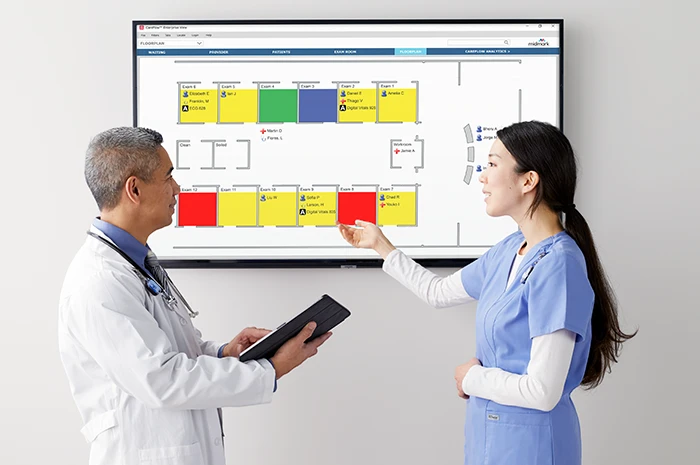
The CareFlow RTLS Enterprise View Floorplan provides a bird’s-eye view of cancer center operations, with real-time prompts and cues that keep patient visits running smoothly.
PATIENT ACCESS: UNLOCKING ADDED CAPACITY
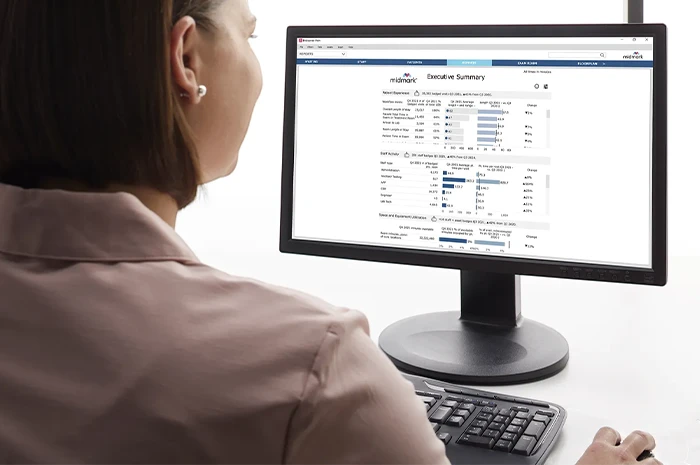
Many healthcare organizations find utilization of space and equipment hovering at surprisingly low rates of 30 to 40%, leaving significant room for improvement. Using CareFlow RTLS data to reflect on trends like peak utilization and average length of stay can help improve patient access and increase revenue potential.
“By analyzing RTLS data, we noticed patients were waiting too long in our infusion clinic,” says David Michelin, MD, MPH, at Munson Healthcare’s Cowell Family Cancer Center. “We handed this data over to a company to create new scheduling templates, making it possible for us to more efficiently use our infusion chairs.”6
Sarah Kadish, MS, formerly director of performance measures and improvement at Dana-Farber, spoke to Healthcare Information and Management Systems Society (HIMSS) conference attendees about how the facility prioritizes patients into exam rooms. Using real-time room status from CareFlow RTLS and appointment times from the scheduling system helped decrease patient wait times for exam rooms by as much as five fewer minutes per patient.4
CareFlow Analytics for Patient Flow also revealed that exam rooms were empty 60% of the time, despite providers complaining they never had available exam space. The unbiased data was used to create a simulation model supporting dynamic room assignments.4
Dana-Farber’s Dr. Bunnell adds, “In the end, we saw a 10% increase in capacity without changing the number of rooms we had. Because of the workflow changes we made, we were essentially able to add two rooms to each floor, just by using that real estate more efficiently.”3
If I’m looking for a patient, I know where the patient is, I know who is with and around that patient, I know what that patient has already done and what they have yet to do.
Dr. Craig Bunnell
Chief Medical Officer
Dana-Farber Cancer Institute
Partnering with
7 of the Top 14
oncology centers in the US
PHARMACY WORKFLOW: INCREASING EFFICIENCY, REDUCING WASTE
“Every time a pharmacist is interrupted during order review, the potential for error rises greatly,” says Northern Light's Farnham. “Prior to the integration of [CareFlow RTLS], treatment nurses would make multiple trips to the pharmacy to see if meds were ready. These interruptions can lead to costly mistakes, because of patient safety and the reimbursement dollars lost from mixing and preparing incorrect medications.”2
With CareFlow in place, Northern Light automates communications with the pharmacy, using icons within the software that change as order status changes. Orders are processed efficiently and without interruptions, improving pharmacy workflow and focus.
Farnham adds, “Now, nurses are always informed by glancing at a monitor. This step alone has saved each treatment nurse from walking more than one mile per day.”2
At the Cowell Family Cancer Center, Dr. Michelin echoes a similar sentiment. “RTLS will alert pharmacists when it is time to mix medications, making it possible to ensure that drugs are not prepared early and then discarded because patients are not ready for treatment. This automation not only enhances the delivery time of medications to patients, it is also a cost savings for our facility.”6
PERIOPERATIVE WORKFLOW: PHYSICIANS ASSESS EFFECTIVENESS OF CAREFLOW IN PEER STUDY
The anesthesiology team at Memorial Sloan Kettering’s Josie Robertson Surgery Center was skeptical of adopting RTLS, debating its effectiveness in perioperative care efficiency. This led Cindy Yeoh, MD, FASA, assistant attending anesthesiologist, and colleagues to develop a study to measure the impact of the technology. Specifically, they sought to establish whether CareFlow would facilitate better communication and improve workflow.
Drawing on data from more than 8,000 patient cases, Josie Robertson’s anesthesiologists who use CareFlow were found to be consistently more efficient. The team’s findings were published in the Journal of Anesthesia & Clinical Research, citing faster time to preoperative anesthesia clearance and shorter duration to anesthesia induction upon patient arrival to the operating room.7
INTEGRATIONS: CAREFLOW RTLS REDUCES DATA ENTRY, ENSURES EMR ACCURACY
Memorial Sloan Kettering’s Dr. Stein attributes CareFlow as one of the keys to improving EMR workflow and the accuracy of data. “At a basic level, the interfaces between RTLS and some of the facility’s clinical information systems allow for the automation of time stamps that otherwise would have been done manually, such as when the patient arrives in the OR, or when he or she leaves the OR.”8
Operating room utilization or turnover time are usually captured manually, making them subject to human error. According to Dr. Stein, “RTLS automatically populating information is something that’s really beneficial when thinking about analytics and ways to optimize the system.”8
The interfaces between the real-time location system and some of the facility’s clinical information systems allow for the automation of time stamps that otherwise would have been done manually.
Dr. Daniel Stein
Director of Informatics and
Innovation
Memorial Sloan Kettering
Cancer Institute
LOOKING FORWARD: ENDLESS POSSIBILITIES FOR ONCOLOGY CARE
Facilities that use CareFlow Patient Flow for Oncology have consistently been recognized and reported on by major national news outlets and industry organizations. In fact, the Association of Community Cancer Centers (ACCC) honored Northern Light Cancer Institute (formerly Eastern Maine Medical Center) with their Innovator Award for their inventive use of CareFlow RTLS technology. “It’s really been transformative as far as our work efficiency. It’s been transformative for our patients,” Allen L’Italien, executive director of Northern Light, told ACCC.9
Reflecting on Dana-Farber’s CareFlow RTLS journey, Dr. Bunnell shares, “There are possibilities within this technology that we don’t think about right now, but the more we use it, the more we’re going to discover those uses. The potential to do everything from ironing out workflow clogs to lowering costs by improving efficiency and capacity is tremendous.”3
1 National Cancer Institute Cancer Statistics.
2 Clements, Brenda, RN, MBA, OCN. “ Location Technology Improves Efficiency, Safety & the Patient Experience,” ACCC-cancer.org, May-June 2016.
3 Health Management Technology. “ Welcome to the Innovation Suite.” June 2016.
4 Kadish, Sarah, MS. “Transforming Process Improvement through RTLS Data.” HIMSS15 Annual Conference & Exhibition, April 14. 2015.
5 HIStalk Interviews Daniel Stein, MD, PhD, Director of Informatics, Memorial Sloan Kettering. March 8, 2017.
6 Michelin, Cindy; Michelin, David MD, MPH. “ How Real-Time Technology Improves Practice Efficiency.” Oncology Times: March 25th, 2017 - Volume 39 - Issue
6 - p 11–12. doi: 10.1097/01.COT.0000515182.94634.04
7 Yeoh, C, Tan KS, Mascarenhas J, Tollinche L. Effects of Different Communication Tools on the Efficiency of Anesthesiologists in the Perioperative Setting.
Journal of Anesthesia & Clinical Research. 2017; 8(12). pii: 794. doi: 10.4172/2155-6148.1000794. Epub 2017 Dec 21. PMID:29399380
8 Healthcare Informatics. “ In New York City, an Outpatient Cancer Surgery Center Built for the ‘Smart’ Future.” March 31, 2016.
9 ACCC-cancer.org. “2015 Innovator Awards.” August 13, 2015.